Friday, March 15, 2013

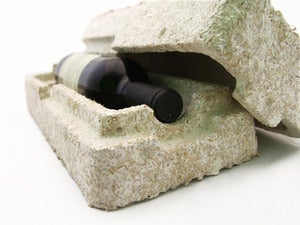
ecofriendly packaging using fungi

I think we've all seen the many styrofoam packing boxes that are used to stabilize products when shipping. Here's an ingenious new eco-friendly take on it using crop residues held together by fungal mycelium. Completely compostable when done!

score one for the fungi

http://www.mushroompackaging.com

(image from URL above)


Thanks to Melanie for pointing this one out!

Tuesday, March 12, 2013

Contact sports and microbiota


Someone did a study on microbiota exchange between athletes during competition. Interestingly enough they chose roller derby as the sport...

Bottom line - by the end of the match where everyone is in contact with each other the individual's microbiota are much more similar to each other. See the figure below - this is an ordination that clusters individuals together based on their microbial composition

http://bodyodd.nbcnews.com/_news/2013/03/12/17270650-roller-derby-skaters-trade-bumps-bruises-and-bacteria?lite

https://peerj.com/articles/53/  for the original journal article. Here's one of the key figures:


I can only imagine what this would look like for something like wrestling

Tuesday, March 5, 2013

Zit microbiomes

Can't help but love the title, eh? So these researchers did microbial analysis both of skin from clear-skinned students and skin from acne-ridden students. The main bacterium Proprionibacteium acne was present on both but when they did genomic analysis they were able to detect strain-level differences. What was different about the two?

P. acne on acne-ridden students: contained "gene islands" associated with skin issues. A "gene island" is a series of genes in the genome that are in the same segment, associated with some particular process, and are often times thought to have entered the genome via some kind of genetic event.

P. acne on healthy skinned-students had genes that had something to do with viral blocking (the secondary source I was reading was not very detailed on this)

current students will find the last couple of paragraphs in the secondary summary articel at Biotechniques to be interesting. Read it and see if you can see Koch's Postulates popping up

Here's the primary resource if anyone wants to follow up on this

Fitz-Gibbon et al. Journal of Investigative Dermatology aop, (2013) | doi:10.1038/jid.2013.21.


Tag cloud feature added

just a technical update - figured out how to add tag clouds related to my blog so now you can click on the tag that interests you and it will pull up all the relevant blog posts - cheers!


Monday, February 18, 2013

Carl Woese

Somehow I missed this but Carl Woese passed away at the end of 2012. Past students will recall his name as the person who discovered that within the prokaryotes there are two major groups of life that are as different from each other as either of them are to the eukaryotes: the Bacteria and the Archaea. I've always loved his story - the scientist who sees something incredible that noone has ever seen, has to fight to get people to believe him, then moves from outcast to hero when the scientific world finally accepts his work.  Woese was bestowed the National Medal of Science - probably the highest scientific award in the US -  in 2000.

(image from news.illinois.edu)


http://www.nytimes.com/2013/01/01/science/carl-woese-dies-discovered-lifes-third-domain.html?_r=0


Wednesday, February 13, 2013

Bacteria in the atmosphere - another extreme environment?

A group out of Denmark recently did biochemical and bacteriological analysis of hailstones. A quick glance at some neat things in here: 

  • bacteria found at a density of ~2000 cells/ml. That's not very high compared to soil at ~10,000,000 cells/g, but hey, this is in a hailstone! 
  • Single cloud droplets however are not individually very poluation. The researchers estimate that 1 in 1,000,000 storm cloud droplets have a a bacterial cell in them. 
  • this paper also touches on the carbon sources and how that may relate to the bacteria

Realize that there are a lot of bacteria hanging out in the atmosphere. There's been a lot of work on this recently, and some of it suggests that these bacteria are metabolically active while up there. There is also research that suggests that these bacteria can act as nucleation points for condensation. I like another statement that is made in this paper that considers the atmosphere as yet another one of our "extreme environments"  - another model for life on other planets perhaps? 


Ĺ antl-Temkiv et al. 2013 Hailstones: A Window into the Microbial and Chemical Inventory of a Storm Cloud. PLOS 


http://www.plosone.org/article/info:doi/10.1371/journal.pone.0053550


Monday, February 11, 2013

Life in subglacial Antarctic lake

Over the past year or so a number of research teams have been drilling deep into glacial ice to get at pockets of water deep below that have been in theory isolated for a very long time from the outside environment. They want to see what exactly can live in those conditions and see if these are some new life forms that we just haven't seen before. What is this environment like? Well, no sunlight penetrating down there, so no light energy driving energy production down there. Very cold too, and the pressure must be reasonably high.

One of the challenges that comes with these studies is that they have to drill a long ways down, and they have to be able to support that any life they find was from the water pocket and not contamination from above carried down by the drill.

There is a nice New York Times article about this that can be found at this link (Feb 6, 2012, Science section). They also have a great photo that shows the first view into one particular lake that I have linked into here. Looks different from what you might expect, yes? There are microbes down there and they are doing things. Keep in mind that this particular subglacial lake is 23 square miles big and ..... 5 feet deep.


We've had a number of students recently who are interested in Astrobiology. Astrobiologists are very interested in microbial life in extreme environments because it helps us understand what kinds of features of life on other planets we might expect to see if we were to find something.

On that note, I noticed that just the other day the Mars rover did a very nice drilling into the surface - will have to read more on this to see if there are plans to check for evidence of life. If so, you can bet that DNA-based approaches will be involved.